Don't let PFAS tag along.
PFAS Assurance Program for Products and Supply Chains
Simplify your PFAS management. Strengthen control upstream.
In real supply chains, PFAS entry points can be widespread and hidden: process water, legacy and auxiliary chemicals, factory infrastructure, and incoming materials and components from third parties.
We deliver a structured PFAS Assurance Program to turn PFAS uncertainty into informed decisions. It combines supplier risk profiling, site assessments, testing, and continuous improvement. We help brands and manufacturers identify potential exposure, build supporting evidence, and strengthen controls across their supply chains.
Most brands check the finished product: one test, at the end, on a few samples. The program moves the checking upstream, to the raw material, the mill and the assembly factory, because that is where the result is decided.
Speak with our
PFAS specialists
The PFAS challenge for brands and manufacturers
PFAS have long been used for durable water-, oil-, and stain-repellent performance in textiles, leather, outdoor products, and other consumer goods. Potential sources extend beyond finished products to chemical formulations, coatings, raw materials, components, and manufacturing processes.
Managing and controlling PFAS across these multiple entry points is challenging, especially when suppliers are geographically dispersed and at different maturity levels in chemical management. Both intentional PFAS use and potential unintended contamination need to be considered.
Brands and manufacturers need a risk-based approach to streamline activities, focus testing where it matters most, and continuously monitor PFAS risks without overwhelming budgets or internal resources.
Why PFAS compliance now means more than a test report
For years, PFAS compliance meant one thing: test the finished product against a limit. That is still necessary. It is no longer sufficient, because the rules have changed shape in four ways.
- The definition has widened
Regulators now define PFAS structurally, covering more than 10,000 substances, rather than listing a handful. A supplier screening against a short list is not looking at what your markets restrict. - The question has changed from “how much” to “was it added on purpose”
US state laws in California, New York, Minnesota, Vermont and others prohibit intentionally added PFAS, at any concentration, and several require a certificate of compliance signed by the seller. A lab can measure how much fluorine is in a sample. It cannot say why it is there. Two products can return the same 60 ppm result: in one, PFAS arrived by accident through shared equipment or a recycled input; in the other, a light water-repellent finish was applied deliberately and kept under the limit. Only the people who made the product can tell those two apart, in writing. - The duty has moved to the importer and the brand
The obligation to know, report and certify follows whoever places the product on the market, whether or not they knew PFAS was in it. US TSCA reporting reaches back to 2011 and asks what you knew or could reasonably have found out from suppliers. EU packaging rules ask for a declaration of conformity backed by a documented trail. - The limits keep falling
California moves from 100 ppm to 50 ppm total organic fluorine in 2027. Denmark applies a 50 mg/kg total fluorine cap to clothing and footwear from July 2026. A product that clears today’s limit can sit above the limit that arrives next.
Our PFAS Assurance Program
Bureau Veritas connects testing, risk profiling, and supplier engagement in one program. We investigate potential sources, turn findings into corrective actions, and support ongoing monitoring as suppliers, materials, and processes change.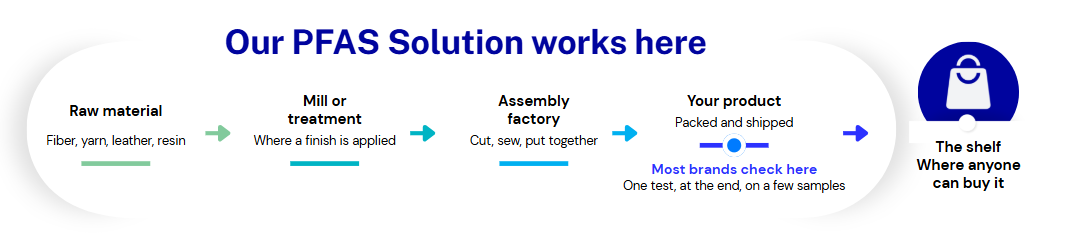
|
|
|
|
|
What your business gains | ||
Clearer Risk | Stronger Supply Chain Evidence | Practical Action and Continuing Control |
Our six step PFAS assurance process
1. Risk Profiling
We begin by profiling supplier and material risk so you can see where PFAS are most likely to appear and where to focus effort, rather than testing everything. This combines targeted questionnaires, factory/process understanding, and high‑level chemical information review.
2. Risk Assessment
High‑risk suppliers undergo deeper assessment—on‑site where needed—to understand processes, materials, and potential PFAS entry points, while low‑risk sites are reviewed via desktop checks. This ensures resources are deployed proportionally to actual risk.
3. Sample Collection and Testing
Based on risk, we define a focused sampling plan and apply total fluorine testing as a first-pass screen, followed by target PFAS analysis where total fluorine exceeds thresholds — to verify whether key materials, products and chemical formulations meet PFAS-free expectations and market-specific limits (e.g. Denmark 50 mg F/kg fluorine cap).
4. Reporting
We deliver clear reports that bring together risk, assessment, and testing outcomes, highlighting where PFAS risks exist and what actions are needed at brand and supplier level.
5. Corrective Action and Follow‑Up
Our specialists support suppliers with root‑cause analysis and recommendations, helping them improve chemical selection, controls, and documentation over time.
6. Continuous Improvement and Surveillance
Through periodic surveillance audits and due-diligence testing, we help you maintain control, confirm progress, and adapt to new regulations, supported by targeted training and shared best practice.
Start with the support your business needs
The program is modular. Begin with supplier profiling, a specific assessment or testing need, corrective action support, or surveillance and training. Connect the services to strengthen the PFAS program you already run.
Support across products and supply chains
Our PFAS Assurance Program supports apparel and textiles, footwear, food packaging, cookware, electronics, raw materials, and chemical producers. Assessment and testing are tailored to the product, material, manufacturing process, and target market.
Activewear & | Food contact products & Packaging | Cosmetic & | ||
Home textile & | Toys | Electronic |
Why brands choose Bureau Veritas for PFAS testing and elimination
✓ | Footwear and apparel-specific expertise: PFAS testing on DWR finishes, membranes, leather, trims and printed labels — across our global ISO 17025 lab network. |
✓ | Risk‑based methodology that directly addresses widespread, hard‑to‑control PFAS sources while reducing reliance on blanket testing. |
✓ | Global laboratory and technical network capable of total fluorine and specific PFAS analyses. |
✓ | More than a lab: audit, supplier declarations, root cause, performance testing, claims substantiation and training under one program, modular to fit what you already run. |
✓ | Alignment with ZDHC, AFIRM, REACH, OEKO‑TEX and brand‑specific RSLs. |
✓ | Actionable insights that translate technical data into practical decisions for sourcing, testing, and supplier engagement. |
Strengthen PFAS control across your supply chain
Partner with Bureau Veritas to identify potential sources, build credible evidence, and take focused action. Contact our team to schedule supplier risk profiling or design a tailored PFAS Assurance Program for your supply chain.
Get a PFAS risk assessment →
Services and testing are tailored to the agreed scope and applicable requirements. Results relate to assessed sites, sampled materials, and the methods used.
PFAS compliance: frequently asked questions
-
Is there a PFAS-free certification?
No. There is no recognized certification that a product is PFAS-free, and “PFAS-free” as a marketing claim is now examined under greenwashing rules. Regulators ask for evidence of no intentionally added PFAS, backed by supplier declarations and test data. That is what the program builds.
PFAS -
My supplier gave me a PFAS-free letter. Is that enough?
A letter records what the supplier believes. It usually covers one tier, one moment and a short list of substances. Verification, through the tiers below and against the definitions your markets use, is what turns belief into evidence you can sign a certificate on.
PFAS -
What does total fluorine testing tell me?
Whether fluorine is present and roughly how much. The fluorine can be originated from any fluorine containing substances, not limited to PFAS. It does not name the substance or say whether it was added on purpose, which is why targeted analysis and supplier declarations sit alongside it.
PFAS -
We comply with the ZDHC MRSL. Does that cover PFAS?
The MRSL v3.1 bans PFAS as a class in chemical formulations, a strong input control. It does not measure what ends up in the product, it covers only the tiers that signed up, and it is voluntary, so it does not on its own produce the certificate or report a law asks for.
PFAS