Ecodesign for Sustainable Products Regulation (ESPR) & Digital Product Passport (DPP)
The European landscape for physical goods is undergoing its most significant transformation in decades. The Ecodesign for Sustainable Products Regulation (ESPR) is no longer a distant prospect - it is the new operational standard. By mandating that products be designed for durability, repairability, and energy efficiency, the EU is moving toward a truly circular economy.
At the heart of this transition lies the Digital Product Passport (DPP). This isn't just a digital tag; it is a powerful vehicle for transparency that tracks a product’s environmental footprint across its entire lifecycle. For forward-thinking businesses, ESPR and DPP represent a unique opportunity to validate sustainability claims and build unprecedented consumer trust.
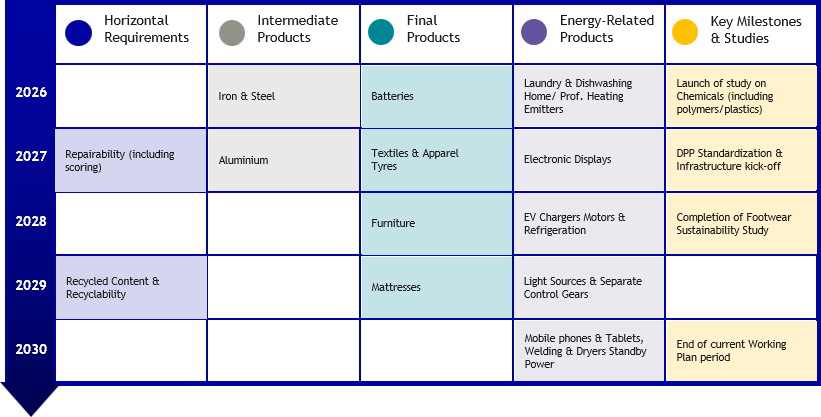
INDICATIVE TIMELINE
The transition has already begun. With the destruction ban on unsold textiles and footwear fast approaching, and specific "Delegated Acts" for priority sectors like electronics and furniture on the horizon, the cost of inaction is high. Non-compliance risks not only heavy financial penalties and market exclusion but also irreparable damage to brand reputation in an increasingly conscious marketplace.
Bridging the Data Gap: The Power of DPP
The Digital Product Passport (DPP) serves as the "single source of truth" for your product, bridging the gap between manufacturers, consumers, and regulators via instant access to verified data. Under ESPR, products must now "speak" for themselves through secure data carriers like QR codes or RFID. These passports provide essential insights into material composition, substances of concern, and circularity potential. The integrity of a DPP rests on its data sources - integrating primary data from raw material provenance to Life Cycle Assessment (LCA) results. Managing this complexity necessitates the validation of data accuracy at every touchpoint, moving beyond simple software entries to a verified digital ecosystem.
The transition to this digital framework follows a phased, manageable timeline. While the ESPR establishes the overarching rules, specific requirements for different product categories will emerge through upcoming Delegated Acts. This structured rollout allows businesses to adapt progressively; there is no need for alarm, as the European Commission will provide clear, sector-specific guidelines well in advance of enforcement. Bureau Veritas delivers the technical Advisory required to identify reliable data sources and verify information before it enters the digital stream. We facilitate a smooth transition, helping you maintain market access as each new regulation takes effect.
BV Solutions: Your End-to-End Compliance Partner
Bureau Veritas delivers a robust suite of technical services to transform the complexities of ESPR and DPP into a verifiable competitive advantage. We act as your independent third-party partner, providing the technical rigor required for regulatory compliance.
1. Regulatory Anticipation & Gap Analysis
Through our specialized Advisory services, we decode the specific requirements of the EU Delegated Acts. We conduct deep-dive assessments of your current product portfolios to identify where your design and supply chain data deviate from the new standards.
2. Supply Chain Traceability & Material Authentication
The DPP requires absolute transparency regarding raw material origins. Our global auditors perform on-site verification from the source to the factory floor. We authenticate claims such as "recycled content" or "organic fibers" through rigorous chain-of-custody audits, preventing the risk of material substitution or adulteration.
3. Performance & Durability Testing
Our laboratories validate your product’s circularity attributes through scientific testing. We execute advanced protocols to measure:
- Product Longevity: Physical testing to confirm durability and wear resistance.
- Chemical Compliance: Screening for Substances of Concern (SoC) to meet ZDHC and REACH requirements.
- Repairability Assessments: Technical evaluations to verify that products can be disassembled and repaired as claimed.
4. Life Cycle Assessment (LCA) & Carbon Footprint
We quantify the environmental impact of your products using standardized LCA methodologies. These verified data points provide the scientific foundation for the environmental disclosures required within the DPP, effectively eliminating the risk of greenwashing.
5. Training & Supplier Empowerment
Sustainability is a collective effort. The BV Academy delivers targeted training modules to upskill your internal teams and global supplier network, fostering a culture of compliance and operational excellence throughout your production ecosystem.