ESPR & DPP:
the traceability horizon for footwear
Why supply chain mapping matters more than ever — and what the EU Digital Product Passport means for the brands that don't yet know where their materials come from.
Speak with our
footwear specialists
One sneaker. ~65 components. A dozen countries. |
A typical athletic shoe is built from materials sourced across 4–6 continents, processed through 5 supplier tiers before it ever reaches a brand's warehouse. |
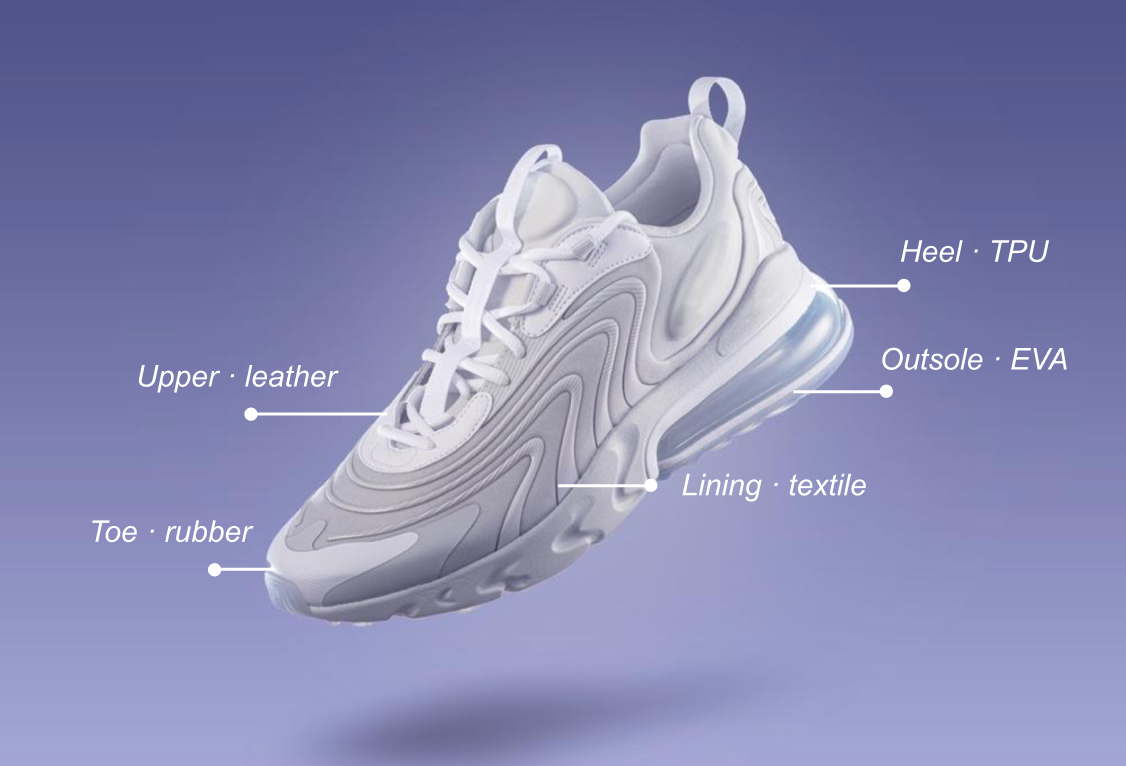
Most brands lose sight of their products |
52% | 12% | 12% | ||
of the world's largest fashion brands publish a Tier 1 supplier list. |
| disclose Tier 2 suppliers (component / processing facilities). |
| publish information about raw-material suppliers. |
Where visibility ends. | |||||||||||||||||||||
Visibility drops sharply at each tier of the footwear supply chain. By the time you reach tanneries, mills, and raw-material suppliers, fewer than one in seven brands can confirm where their materials come from. | |||||||||||||||||||||
| |||||||||||||||||||||




Every footwear product sold in the EU will carry a digital passport. |
The EU Digital Product Passport (DPP) becomes mandatory for footwear placed on the EU market in 2030. Every brand selling into the EU will need to provide verifiable, traceable data covering each product’s full lifecycle, from raw materials to end-of-life. |
What every footwear product will carry by 2030. | |
|
|
An ideal actionable roadmap from now to 2030. | ||
01 | 2026 | Now |
02 | 2027 | Pilot phase |
03 | 2028 | Build year |
04 | 2029 | Verification |
05 | 2030 | Mandatory |
BUsiness could be Impacted if you're not ready by the deadline. |
EU regulators have set the deadlines. The market will enforce them. Brands and manufacturers that wait for the rules to land before acting will be running into multiple converging consequences at once. |
MARKET ACCESS DENIED |
| PENALTIES & CUSTOMS HOLDS |
TIME RUNS OUT |
| REPUTATIONAL EXPOSURE |
Five capabilities. One chain of evidence. |
From the suppliers you contract directly to the farms, mills, and forests behind your raw materials, traceability requires connected systems and verified data at every stage. These five capabilities form the chain of evidence the EU regulation will demand. |
Supplier mapping | Facility audits | Material origin |
Data systems | Digital passport |
How Bureau Veritas helps. |
From supplier mapping to verified DPP data, Bureau Veritas brings a full suite of solutions to help footwear brands and manufacturers get ESPR-ready and DPP-ready. Testing, inspections, audits, certifications, LCA, claims verification, advisory, and platform integration: every capability you need, in one program. |
TESTING Learn more: material and chemical For: ESPR · REACH · Restricted Substances |
| INSPECTIONS For: DPP traceability · EUDR Due Diligence |
AUDITS For: CSDDD · DPP Environmental data |
| CERTIFICATIONS For: Green Claims Directive · DPP |
LCA For: ESPR · DPP Environmental impact |
| DATA VERIFICATION For: ESPR Articles 7(5), 10–11 |
ADVISORY For: ESPR · EUDR · PPWR · Green Claims |
| PLATFORM INTEGRATION For: ESPR · DPP Registry |
More than compliance. | ||
Bureau Veritas brings an end-to-end footwear supply chain solution: testing, certification, quality assurance, advisory, and platform integration in one program. Everything you need to stay DPP-compliant and to build sustainable shoes on a sustainable supply chain. Brands and manufacturers don’t just get compliant with us. They capture measurable returns at every level: less rework, faster lead times, lower cost, better margin. | ||
| OLD MODEL | NEW MODEL | |
Test the shoe at the end. | → | Build traceability and quality from source. |
| Finished-product inspection only. No visibility into materials or production. Recalls discovered after shipping. Full rework costs on failure. Brand reputation exposed. | Upstream QA at tanneries and mills. In-line inspection on the production floor. Full-chain traceability and DPP-ready data. Compliance built in. Margin protected. | |
Up to 4% | 20-50% | Up to 90% | Up to 20%+ |
| FOB price reduction Margin recovered | Faster lead times After BV-led transformation | Less leather rework 5.7M → 0.54M sq ft | Defect-rate reduction Achieved within 5 months |
| Results From Bureau Veritas footwear solutions across the value chain. | |||
Where does your supply chain visibility end? |
Be DPP-ready. Be ESPR-compliant. |
Before it’s too late. Bureau Veritas helps footwear brands and manufacturers build the supplier mapping, material traceability, and verified data systems the EU regulation will demand. Talk to us before the deadlines do.

SOURCES
- Fashion Revolution · Fashion Transparency Index 2023
- McKinsey · 2025 Supply Chain Risk Pulse Survey
- EcoVadis · Supply Chain Visibility Survey
- Bureau Veritas Consumer Products Services